Building a tiny house in Minecraft isn’t just about saving blocks, it’s about mastering efficiency, creativity, and design constraints that mirror real-world compact living. Whether players are starting fresh in survival mode with limited resources or challenging themselves to create cozy builds in a confined footprint, tiny houses offer a rewarding middle ground between starter dirt shacks and sprawling mansions. The skills learned building small translate directly to better resource management, smarter spatial planning, and more intentional design choices across every Minecraft project.
Table of Contents
ToggleKey Takeaways
- Building a Minecraft tiny house teaches essential design skills like resource management, spatial planning, and intentional block placement that transfer to larger projects.
- A tiny house foundation of 5×5 or 7×7 blocks uses significantly fewer materials than larger structures, making them ideal for survival mode bases and quick resource conservation.
- Multi-purpose spaces, vertical building, and smart storage solutions like stacked barrels and hidden chest storage are critical for maximizing functionality in compact Minecraft tiny houses.
- Consistent material palettes (limit to 2-3 primary block types), proper lighting placement, and scaled-down furniture using stairs and slabs prevent cramped interiors from feeling overwhelming.
- Integration with surrounding landscaping—including pathways, gardens, and porches—transforms a basic tiny house structure into a polished, intentional build that fits its environment.
Why Build a Tiny House in Minecraft?
Tiny houses serve multiple practical purposes in Minecraft gameplay. In survival mode, they require fewer materials to complete, letting players establish a secure base quickly while conserving resources for tools, weapons, and armor. A basic 5×5 or 7×7 structure uses roughly 60-80 blocks for walls compared to 200+ for a medium house.
Compact builds also teach fundamental design skills. Working within tight constraints forces players to make intentional choices about every block placed, there’s no room for filler or wasted space. This discipline carries over to larger projects, resulting in tighter, more purposeful builds.
From a gameplay perspective, tiny houses integrate seamlessly into various base styles. They work as starter homes, secondary outposts near mining operations, villager trading posts, or thematic builds in curated worlds. The smaller footprint means less time spent on construction and more time exploring, mining, or farming.
Finally, tiny house challenges have become popular in the Minecraft community. Self-imposed limits, like building within a 5×5 footprint or using only three block types, push creative problem-solving and generate unique results that stand out from cookie-cutter builds.
Essential Design Principles for Minecraft Tiny Houses
Successful tiny house design starts with vertical thinking. When horizontal space is limited, build upward. A two-story 5×5 house offers 50 blocks of floor space versus 25 in a single-story version. Use ladders, trapdoors, or compact staircases to connect levels without eating valuable square footage.
Multi-purpose spaces are critical. A single room can function as bedroom, crafting area, and storage if organized properly. Place a bed against one wall, crafting table and furnace on another, and use the remaining walls for chest storage. Avoid dedicating entire rooms to single functions, that’s a luxury tiny builds can’t afford.
Entryway design impacts both aesthetics and function. Recessed doors (set one block into the wall) save exterior space and create visual depth. Alternatively, double doors on a 5×5 build waste precious interior blocks: stick with single doors or use trapdoors for ultra-compact entries.
Lighting requires extra attention in small spaces. Poor illumination makes tiny interiors feel cramped and spawns hostile mobs. Place torches or lanterns at ceiling height, use glowstone or sea lanterns integrated into the floor or walls, or hide lighting behind trapdoors for ambient glow without visual clutter.
Exterior shape matters for material efficiency. Square or rectangular footprints use blocks more economically than circular or diagonal designs, which require more partial blocks and generate more waste. Save complex geometries for larger builds where the material cost is less critical.
Maximizing Space with Smart Storage Solutions
Storage often becomes the bottleneck in tiny houses. Standard chest placement along walls works, but double chests (which occupy two blocks) can overwhelm a small room. Consider these alternatives:
- Barrels function identically to chests but can be stacked vertically and opened even with blocks above them. A 2-high barrel column provides double storage in the same footprint.
- Ender chests offer accessible storage from any location without occupying multiple houses with redundant chests.
- Shulker boxes inside chests effectively multiply storage capacity, though they require End-game access.
Integrate storage into furniture. Use upside-down stairs with chests underneath to create seating with hidden storage. Place chests beneath beds (beds occupy the upper block space, leaving the lower block free). Many builders overlook compact storage techniques that work equally well in both virtual and physical spaces.
Avoid chest clutter by categorizing items strictly. One chest for building blocks, one for tools and weapons, one for food and farming supplies. Label chests using item frames with representative items, this visual system prevents opening every chest to find what’s needed.
Step-by-Step Guide to Building Your First Tiny House
Materials needed for a basic 7×7 tiny house:
- 80-100 blocks of primary building material (oak planks, stone bricks, etc.)
- 20-30 blocks of secondary material for accents (logs, stone, etc.)
- 10-15 glass blocks or panes for windows
- 1 door
- 20-25 blocks for roofing (stairs, slabs, or solid blocks)
- Torches or other light sources
- Interior furniture (bed, crafting table, furnace, chests)
Step 1: Mark the foundation. Place blocks in a 7×7 square outline. For a 5×5 ultra-compact build, adjust accordingly. Ensure the ground is level, fill low spots or dig out high spots to create a flat build surface.
Step 2: Build walls three to four blocks high. Three blocks allows just enough headroom: four provides space for ceiling details or hanging lanterns. Leave a one-block gap for the door and two or three gaps for windows.
Step 3: Install windows and door. Glass panes use less visual space than full glass blocks. Position windows to maximize natural light while maintaining wall space for interior furniture.
Step 4: Construct the roof. Simple designs include:
- Flat roof: Slabs across the top (uses fewer blocks, modern aesthetic)
- Peaked roof: Stair blocks arranged in a pyramid or gabled shape (traditional, sheds rain in visual terms)
- Overhanging roof: Extend roof blocks one block beyond walls for depth
Flat roofs on tiny houses can double as rooftop gardens or observation decks if accessed by ladder.
Step 5: Add interior lighting before placing furniture. This prevents dark corners that require later adjustments. Place torches at opposite corners or embed glowstone in the floor with carpet over it.
Step 6: Arrange furniture strategically. Place the bed first (required for respawn), then crafting table and furnace along one wall, then storage chests. Leave a clear path from door to bed, cramped navigation frustrates daily use.
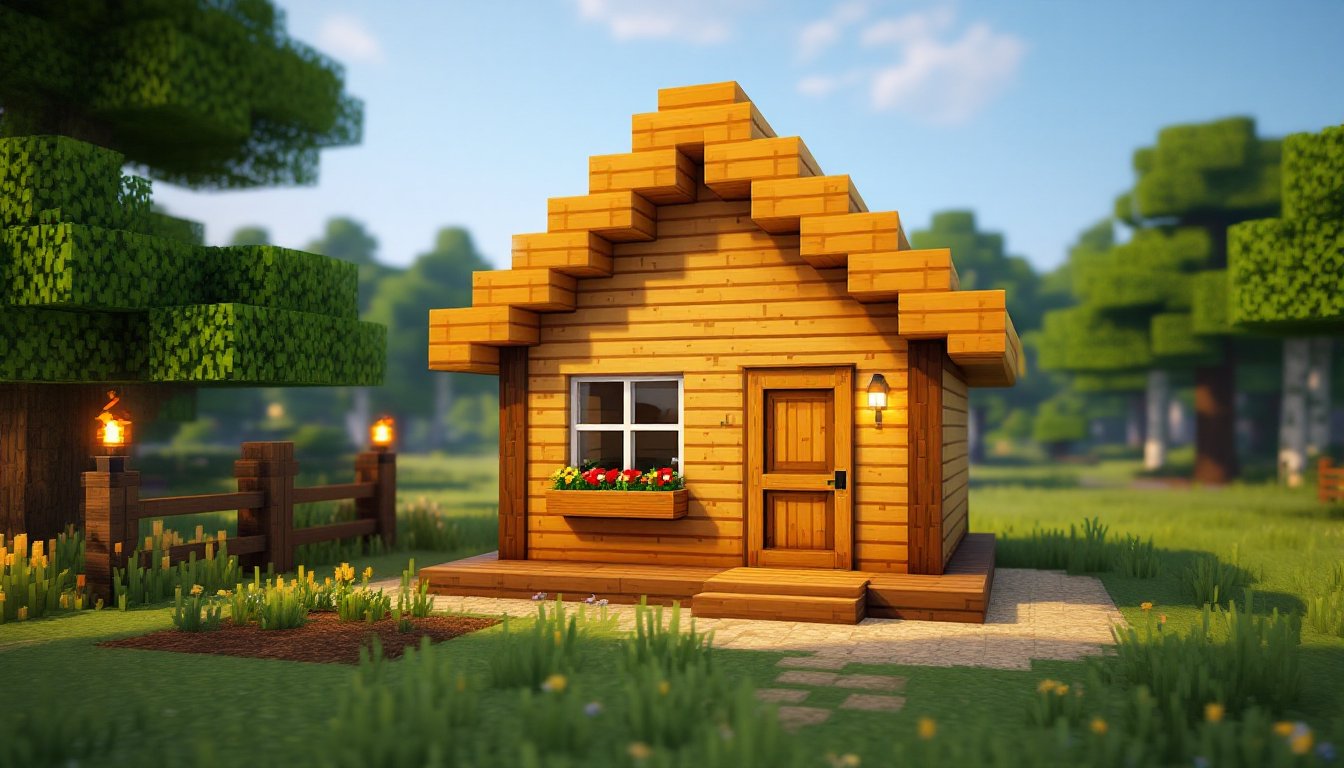
Step 7: Add exterior details. Flower boxes under windows, a small porch (even one block deep adds character), path blocks leading to the door, or surrounding landscaping integrates the build into its environment. These decorative finishing touches transform basic structures into polished builds.
Creative Tiny House Design Ideas and Themes
Rustic cabin: Use oak or spruce logs for walls, dark oak planks for flooring, and cobblestone or stone brick accents. Add a small chimney using stone bricks and a fireplace (campfire or netherrack behind iron bars). Include window boxes with flowers and a covered porch with log pillars.
Modern minimalist: Stick to concrete, white concrete, and black concrete in clean geometric shapes. Use large glass pane windows, quartz or smooth stone for accents, and sea lanterns or shroomlights for modern lighting. Keep decoration minimal, less is more.
Underground bunker: Excavate a tiny house entirely below ground level. Use stone variants for walls to match surrounding terrain. Skylights (glass blocks at ground level) provide natural light without exposing the structure. Excellent for stealth survival bases.
Treehouse tiny home: Build a compact 5×5 structure in tree canopy using jungle wood or oak planks. Connect to ground via ladder or vine column. Limit footprint to preserve the tree aesthetic, tiny houses excel in constrained spaces like tree platforms.
Shipping container style: Use cyan or light blue concrete to mimic corrugated metal. Build a long, narrow 4×8 or 4×10 rectangle with corrugated details using slabs and stairs. Add industrial touches like iron bars for windows and stone pressure plates as floor details.
A-frame design: Create steeply angled walls that reach from ground to peak, with minimal vertical wall space. The structure itself becomes the roof. Use stairs and slabs to form the A-shape, leaving the front and back faces open for glass walls. Extremely material-efficient and visually distinctive.
Thematic builds benefit from consistent block palettes. Limit primary materials to two or three types plus glass, too much variety in a tiny space creates visual chaos. Detailed building tutorials often emphasize this cohesive material approach for maximum impact.
Interior Design Tips for Compact Minecraft Spaces
Furniture scale matters in tight quarters. Avoid oversized pieces like 3×3 tables or double-bed builds (standard bed is sufficient). Use slabs and stairs creatively to suggest furniture without occupying full blocks:
- Chairs: Stair blocks or single slabs
- Tables: Fence posts with pressure plates on top, or single slabs
- Counters: Upside-down stairs create a countertop profile
- Shelves: Trapdoors mounted on walls with items displayed on them
Similar to real tiny bedrooms, Minecraft spaces benefit from furniture that serves multiple purposes and doesn’t overwhelm the room.
Color psychology applies even in blocky form. Lighter blocks (white concrete, birch planks, quartz) make small spaces feel larger and brighter. Darker blocks (dark oak, blackstone, black concrete) can feel cozy but may close in the space if overused. Use dark colors as accents rather than dominant tones.
Flooring choices impact perceived size. Consistent flooring throughout makes spaces flow and feel larger. Mixing floor types in a tiny house fragments the already-small space. Carpet adds warmth and works over any solid block, providing color options without replacing structural flooring.
Wall decoration should be minimal but intentional. One or two item frames with tools, maps, or paintings add personality without clutter. Avoid covering every wall surface, negative space gives eyes places to rest.
Ceiling details often get neglected. Exposed wood beams (fence or log posts), recessed lighting (glowstone behind trapdoors), or a simple contrasting ceiling color adds dimension. In a 4-block-high room, add beams at the 3-block level to create visual interest without reducing headroom.
Zoning within a single room helps organize function. Use subtle floor changes (one corner with different carpet), partial walls (fence or wall blocks that don’t fully divide the space), or furniture arrangement to suggest separate areas for sleeping, crafting, and storage without building actual walls.
Common Mistakes to Avoid When Building Small
Overcrowding kills tiny house functionality. New builders try cramming every possible feature, enchanting table, anvil, brewing stand, multiple furnaces, into 25 square blocks. Prioritize essentials for the build’s purpose. Secondary functions can be housed in small external sheds or basement areas.
Ignoring exterior proportions creates awkward builds. A 5×5 house with a roof that adds three blocks of height looks top-heavy. Keep roof pitch proportional to base size, smaller footprints need lower-profile roofs.
Poor door placement wastes space. Centering a door on a 5×5 wall seems logical but creates asymmetrical interior layout problems. Offset the door to one side, leaving a full wall section for furniture placement.
Forgetting the entry experience leaves builds feeling unfinished. Even a single block of porch, a doormat (trapdoor), or flanking flower pots creates intentional threshold space. Players enter and exit constantly, make it feel deliberate.
Inadequate lighting frustrates gameplay. Dark corners spawn mobs in survival mode and make navigation difficult. Light level of 8 or higher prevents mob spawns: aim for light level 12-15 in living spaces for visibility and safety.
Window size mismatches create balance issues. One large 3-block window on a 7-block wall overwhelms the facade. Multiple smaller windows or symmetrical placement looks more intentional. Windows should illuminate interior without compromising wall space needed for furniture.
Building without a plan leads to rebuilds. Even a rough sketch of room layout, furniture placement, and material palette saves blocks and time. Knowing where the bed, crafting area, and storage will go before building walls prevents “I should have made this room bigger” regrets.
Skipping landscaping leaves builds floating in space. Tiny houses especially benefit from integration with surroundings, path blocks leading to the door, cleared area around the structure, small garden plots, or fencing creates context. A 5×5 house in a thoughtfully designed 12×12 plot feels intentional: the same house plopped randomly feels unfinished.
Finally, ignoring scale creep during construction. It’s tempting to add “just one more block” to each dimension, but a 7×7 that becomes 9×9 isn’t a tiny house anymore. Set hard limits before starting and stick to them, constraints drive creativity.