Japanese indoor plants bring calm, structure, and natural beauty into any living space. Rooted in centuries of horticultural tradition, these plants emphasize simplicity, balance, and mindful care, principles borrowed from Japanese aesthetics like wabi-sabi and Zen gardens. Whether someone’s looking to add a sculptural bonsai to a bookshelf or soften a corner with graceful bamboo, these plants offer both visual appeal and a grounding presence. They don’t just decorate: they invite a slower, more deliberate approach to home design.
Table of Contents
ToggleKey Takeaways
- Japanese indoor plants emphasize simplicity, balance, and mindful care rooted in centuries of horticultural tradition, fitting seamlessly into modern minimalist and contemporary interiors.
- Beginner-friendly Japanese indoor plants like lucky bamboo, peace lilies, and Ficus bonsai thrive in compact spaces with minimal water and light compared to tropical varieties, making them ideal for apartments and north-facing rooms.
- Proper care of Japanese indoor plants requires consistent watering without waterlogging, bright indirect light for 4–6 hours daily, regular pruning to maintain shape, and repotting every 2–3 years to ensure healthy growth.
- Styling Japanese-inspired indoor gardens follows principles of negative space and restraint—select one or two statement plants rather than crowding surfaces, and pair them with complementary natural elements like river stones or driftwood.
- Japanese indoor plants cultivate daily care rituals that encourage mindfulness and intentional living, transforming plant maintenance from a chore into active participation in home design and personal well-being.
Why Japanese Indoor Plants Are Perfect for Modern Homes
Japanese-inspired greenery fits seamlessly into contemporary interiors. Unlike the sprawling tropical big leaf varieties that demand floor space and humidity, many Japanese plants thrive in compact settings with minimal fuss. They emphasize form over size, clean lines, intentional shaping, and restrained growth.
These plants also align with modern sustainability trends. Most require less water than their tropical counterparts, and many tolerate lower light conditions, making them ideal for apartments or north-facing rooms. The care rituals, pruning, watering, repositioning, become a form of active participation rather than a chore.
From a design standpoint, Japanese plants introduce texture and movement without overwhelming a room. A well-placed bonsai or a cluster of bamboo stalks adds architectural interest to minimalist spaces. They work equally well in Scandinavian-inspired homes, industrial lofts, or traditional settings. The key is restraint: select one or two statement plants rather than crowding every surface.
Best Japanese Indoor Plants for Beginners
Bonsai Trees: The Art of Miniature Nature
Bonsai isn’t a species, it’s a cultivation technique that miniaturizes trees through careful pruning, wiring, and root trimming. Common beginner-friendly varieties include Ficus retusa (Chinese banyan), Juniperus procumbens (Japanese juniper), and Carmona retusa (Fukien tea).
Ficus bonsai tolerate indoor conditions better than most. They need bright, indirect light, about 4–6 hours daily, and consistent watering. The soil should dry slightly between waterings: overwatering kills more bonsai than neglect. Use a well-draining bonsai mix (akadama clay, pumice, and lava rock) rather than standard potting soil, which retains too much moisture.
Juniper bonsai are technically outdoor plants but can spend short periods indoors during winter in cold climates. They require a dormancy period with cooler temperatures (35–50°F) for 8–12 weeks annually. Skip this, and the tree weakens over time.
Pruning maintains shape and encourages dense foliage. Trim new growth back to 2–3 leaf pairs during the growing season (spring through early fall). Safety note: Use sharp, clean bonsai shears to prevent disease transmission between cuts. Wear safety glasses when wiring branches, snipped wire ends can spring back.
Traditional kokedama planting offers an alternative to potted bonsai, wrapping roots in moss balls for a hanging or tabletop display.
Lucky Bamboo and Peace Lily Varieties
Lucky bamboo (Dracaena sanderiana) isn’t actually bamboo, it’s a tropical water lily relative. It thrives in low to moderate indirect light and can grow in water or soil. When grown in water, change it weekly to prevent algae and bacterial buildup. Use distilled or filtered water: tap water’s chlorine and fluoride can cause leaf tip burn.
Arrange stalks in groups of 3, 5, or 8 for traditional presentation (avoid 4, which carries negative connotations in Japanese numerology). Stalks can reach 2–3 feet if unrestricted, but most homeowners trim them to 12–18 inches for tabletop display.
Peace lilies (Spathiphyllum), while not exclusively Japanese, appear frequently in Japanese-inspired interiors for their sculptural white blooms and glossy foliage. They tolerate low light better than most flowering plants, making them suitable for bathrooms or interior rooms, and signal watering needs by drooping slightly (they perk up within hours of watering).
Both plants filter indoor air pollutants like benzene and formaldehyde, though you’d need multiple plants per room for measurable air quality improvement. Peace lilies are toxic to cats and dogs if ingested, causing oral irritation and digestive upset. Keep them out of reach if pets are present.
Caring for Your Japanese Indoor Plants
Watering: Most Japanese plants prefer consistent moisture without waterlogging. Check soil moisture 1–2 inches below the surface before watering. For bonsai, water until it drains from the bottom, wait 10 minutes, then water again, this ensures the entire root ball is saturated.
Light requirements: Bonsai and lucky bamboo need bright, indirect light. A south- or west-facing window with sheer curtains works well. Peace lilies adapt to lower light but bloom more reliably with 4+ hours of indirect sun daily. Rotate plants 90 degrees weekly to encourage even growth.
Humidity: Japanese plants generally tolerate average household humidity (40–50%), though peace lilies appreciate occasional misting. Avoid placing plants near heating vents or drafty windows, which cause rapid moisture loss and stress.
Fertilizing: Feed bonsai with diluted liquid fertilizer (half-strength balanced 10-10-10 or specialized bonsai formula) every 2–4 weeks during the growing season. Stop fertilizing in late fall and winter when growth slows. Lucky bamboo in water needs diluted liquid fertilizer monthly: those in soil follow standard houseplant schedules. Peace lilies benefit from monthly feeding during active growth with a balanced 20-20-20 formula.
Pruning and shaping: Bonsai require regular maintenance, pinch back new shoots, remove crossing branches, and wire young growth to direct shape. Use annealed copper or aluminum wire wrapped at 45-degree angles: remove after 3–6 months before it cuts into bark. Peace lilies need only occasional deadheading of spent blooms and removal of yellowing leaves at the base.
Repotting: Bonsai typically need repotting every 2–3 years in early spring. Trim 1/3 of the root mass with clean shears, remove old soil, and replant in fresh bonsai mix. Lucky bamboo in water doesn’t need repotting but benefits from container changes if algae develops. Peace lilies prefer slightly cramped conditions, repot only when roots visibly circle the pot or growth slows, usually every 18–24 months.
Pest management: Watch for spider mites (fine webbing between leaves), scale (brown bumps on stems), and mealybugs (white cottony clusters). Isolate affected plants immediately. Treat with insecticidal soap or neem oil spray, coating undersides of leaves thoroughly. Repeat applications every 7 days for 3 weeks. Safety note: Use neem oil in well-ventilated areas and wear gloves, it can irritate skin.
Styling Tips: Creating a Japanese-Inspired Indoor Garden
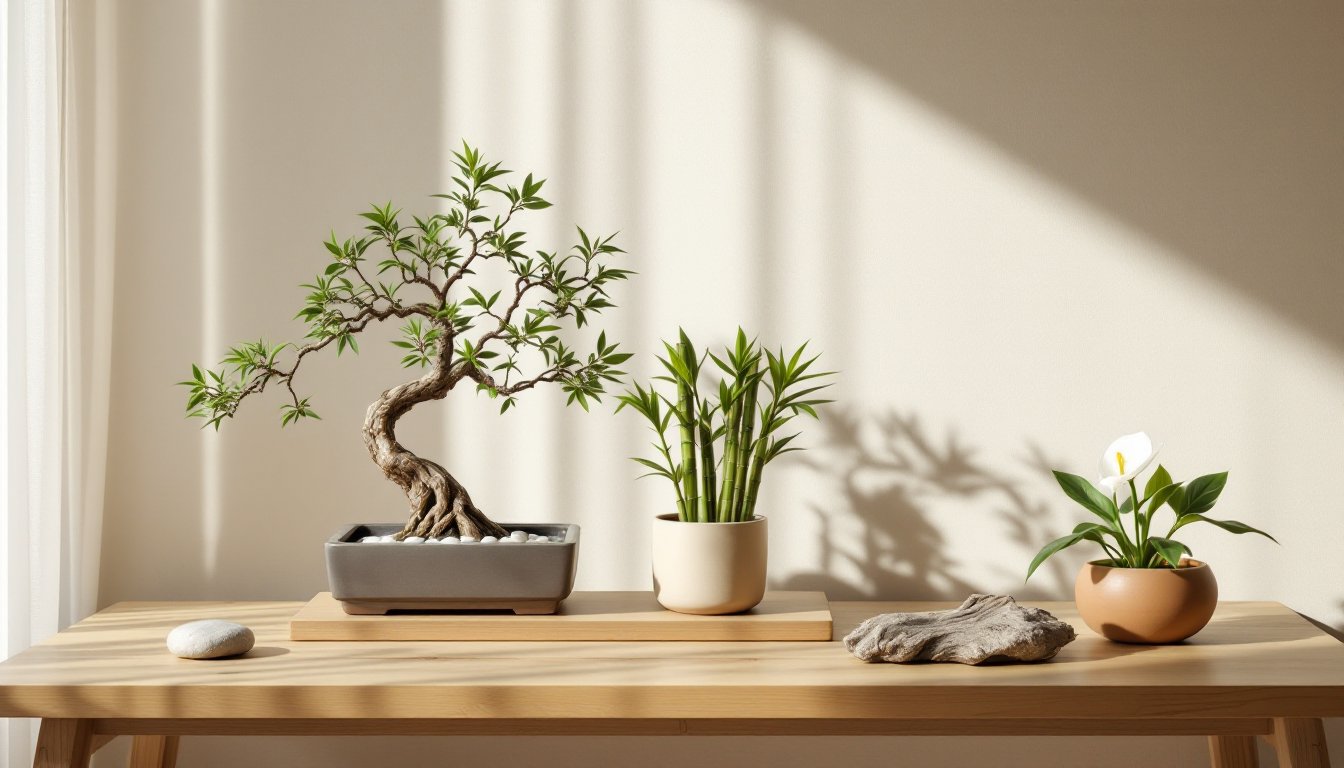
Japanese design emphasizes negative space (ma), natural materials, and asymmetry. Rather than filling every surface, select a few carefully chosen plants and give them room to breathe. A single bonsai on a simple wooden stand creates more impact than a crowded shelf.
Container selection: Choose unglazed ceramic pots in neutral tones, grays, browns, blacks, or muted greens. Rectangular or oval bonsai pots work for trees: cylindrical containers suit bamboo. Avoid bright colors or busy patterns that compete with the plant. Drainage holes are non-negotiable for soil-grown plants: place saucers underneath to protect surfaces.
Display principles: Position plants at varying heights using wooden platforms, floating shelves, or tokonoma-inspired alcoves. In traditional Japanese homes, the tokonoma is a recessed space for displaying art or plants, a living room corner with a simple shelf achieves similar effect.
Pair plants with complementary elements: smooth river stones, a small water feature, or a piece of driftwood. These add textural contrast without clutter. Incorporating modern plant decor approaches can help balance traditional Japanese aesthetics with contemporary interiors.
Lighting: Natural light is ideal, but if that’s limited, use full-spectrum LED grow lights (5000–6500K color temperature) mounted 12–18 inches above plants. Run them for 12–14 hours daily to supplement weak winter light. Avoid incandescent bulbs, which generate heat and lack necessary wavelengths.
Grouping plants: Create visual interest by combining plants with different textures and growth patterns. Pair a vertical lucky bamboo arrangement with a low, spreading peace lily, or contrast a sculpted bonsai with the unusual foliage of a nearby accent plant. Limit groupings to 2–3 plants to maintain simplicity.
Accent elements: A simple bamboo water fountain (recirculating pump models use minimal electricity) adds gentle sound and humidity. Place it near plants that appreciate extra moisture, but ensure it’s at least 12 inches from wood furniture to prevent water damage.
Seasonal adjustments: Rotate displays with the seasons. In spring, highlight flowering plants: in winter, emphasize evergreen bonsai and structural elements. This keeps the space dynamic without requiring major overhauls. Research on garden aesthetics demonstrates how seasonal rotation increases engagement with indoor spaces.
Maintenance integration: Keep pruning shears, a small watering can, and a spray bottle nearby in a simple basket or tray. Making tools visible and accessible encourages regular care. Japanese design doesn’t hide function, it integrates it elegantly.
For those interested in expanding beyond Japanese varieties, exploring large indoor plants can complement smaller Japanese specimens by creating layered visual depth.
Conclusion
Japanese indoor plants offer more than decoration, they create focal points that encourage mindfulness and intentional living. Starting with hardy varieties like lucky bamboo or peace lilies builds confidence, while bonsai cultivation develops patience and observational skills. The investment isn’t just in plants, but in the daily rituals of care that ground a home in natural rhythms.