Tropical big leaf plants don’t whisper, they command attention. With foliage that can span two feet or more, these architectural specimens turn any room into a statement space. But they’re not just about looks. Most species are surprisingly forgiving, adapting to indoor conditions better than their jungle origins might suggest. The key is understanding what each plant needs and matching it to your space. Whether dealing with a sun-drenched corner or a dim hallway, there’s a big leaf tropical that can thrive there.
Table of Contents
ToggleKey Takeaways
- Tropical big leaf house plants command visual attention with foliage spanning two feet or more while naturally improving air quality through photosynthesis and humidity regulation, making them functional décor investments.
- Monstera deliciosa and fiddle leaf fig are top choices for big leaf tropicals, with Monstera being nearly impossible to kill with basic care and fiddle leaf fig requiring consistency in light, watering, and location for optimal growth.
- Successful tropical big leaf plant care depends on well-draining potting mix with 30% perlite, moderate watering schedules every 7–10 days, and bright indirect light, while repotting every 12–18 months supports healthy growth.
- Bird of Paradise thrives in the brightest spots of your home and can reach 5–6 feet tall indoors, making it ideal for high-ceilinged rooms and entryways where its dramatic foliage creates a natural focal point.
- Large tropical plants require thoughtful placement with 12–18 inches of clearance on all sides, lightweight fibergree pots instead of heavy ceramic, and moisture-catching saucers with pads to protect floors from water damage.
- Supplement insufficient natural light with full-spectrum LED grow lights positioned 12–24 inches above the plant canopy for 10–12 hours daily, allowing tropical species to thrive in low-light urban environments.
Why Choose Big Leaf Tropical Plants for Your Home?
Big leaf tropicals do more than fill empty corners. Their oversized foliage increases surface area for photosynthesis, which means better air filtration. A single mature Monstera can transpire nearly a liter of water per day, raising humidity levels in dry indoor environments, a bonus during winter months when forced-air heating saps moisture from the air.
From a design perspective, one large plant often works better than a cluster of small ones. It creates a focal point without visual clutter. Rooms with high ceilings or open floor plans benefit most: the vertical growth and broad leaves help balance scale in ways that low-profile furniture can’t.
Maintenance is also simpler than most people assume. Large leaves are easy to dust with a damp cloth, and infrequent watering schedules (every 7–10 days for many species) suit busy households. These aren’t finicky orchids. They evolved to handle inconsistent rainfall and dappled light beneath forest canopies, so they tolerate the imperfect conditions found in most homes.
Best Tropical Big Leaf House Plants for Indoor Spaces
Monstera Deliciosa: The Classic Statement Plant
The Monstera deliciosa, also called Swiss cheese plant, is the workhorse of big leaf tropicals. Mature leaves can reach 24–36 inches across, with fenestrations (natural splits and holes) that increase as the plant ages. Younger plants produce solid leaves: the signature splits appear once the plant has established a strong root system.
Light requirements are flexible. Monstera tolerates low light but grows faster and develops more dramatic fenestrations in bright, indirect light, think 6–8 feet from an east- or west-facing window. Direct sun scorches the leaves, leaving brown patches that won’t heal.
Watering follows a simple rule: let the top 2–3 inches of soil dry out between waterings. Overwatering causes root rot faster than underwatering kills the plant. Use a moisture meter if uncertain: it’s a $10 tool that eliminates guesswork. Monstera also appreciates a moss pole or trellis for support, as it’s a natural climber. The aerial roots will grip the support, encouraging larger leaf development.
Those interested in large indoor house plants often start with Monstera because it’s nearly impossible to kill with basic care.
Fiddle Leaf Fig: Bold Drama for Any Room
The Ficus lyrata (fiddle leaf fig) became an interior design darling for good reason. Its violin-shaped leaves can stretch 15 inches long and 10 inches wide, creating a sculptural silhouette that photographs well and anchors modern spaces.
But it’s pickier than Monstera. Fiddle leaf figs demand consistency, same watering schedule, same location, same light levels. Move it around or let the soil dry out completely, and it’ll drop leaves in protest. Place it in a spot with bright, filtered light for at least 6 hours daily. South-facing windows work if sheer curtains diffuse the intensity.
Water when the top inch of soil feels dry, usually once a week in most homes. Always use a pot with drainage holes: sitting water is a death sentence for Ficus roots. If leaves develop brown edges, check humidity levels. Fiddle leaf figs prefer 40–60% humidity, which often requires a humidifier in winter or grouping plants together to create a microclimate.
Dust buildup is a common issue with those broad leaves. Wipe them down every two weeks with a damp microfiber cloth. Dust blocks light absorption and invites pests like spider mites. Readers exploring big leaf house plants should know Ficus requires more attention than most tropicals but rewards effort with stunning vertical growth, mature specimens can reach 6–10 feet indoors.
Bird of Paradise: Bringing Exotic Beauty Indoors
Strelitzia nicolai (white bird of paradise) and Strelitzia reginae (orange bird of paradise) both offer dramatic foliage, though nicolai grows larger and suits indoor cultivation better. Its paddle-shaped leaves can reach 18 inches wide and 3–4 feet long, resembling banana plant foliage.
This plant craves light. Place it directly in front of a south- or west-facing window, as close as possible without touching the glass. Insufficient light causes leggy growth and smaller leaves. Bird of paradise tolerates some direct sun, unlike most tropicals, making it ideal for bright, unobstructed spaces.
Watering needs are moderate, every 1–2 weeks depending on pot size and light exposure. The plant will droop slightly when thirsty, which is a reliable indicator. Use a well-draining potting mix with added perlite or bark: heavy, moisture-retentive soil encourages root rot.
Strelitzia doesn’t branch naturally, so it grows as a single or multi-stemmed clump. To encourage fullness, some growers plant multiple specimens in one large container (a 14–16 inch diameter pot minimum for a mature plant). Be prepared for its size, bird of paradise commonly reaches 5–6 feet tall indoors, with a spread nearly as wide. It’s not for tight quarters.
Those exploring varieties among unusual house plants will appreciate that mature Strelitzia occasionally blooms indoors, though it requires several years of growth and intense light. According to Gardenista’s guide on large-leaf houseplants, the flowers are architectural in their own right.
Essential Care Tips for Healthy Big Leaf Tropicals
Potting mix matters. Standard potting soil holds too much moisture for most tropicals. Mix in 30% perlite or orchid bark to improve drainage and aeration. Roots need oxygen as much as water. Compacted soil suffocates roots and promotes fungal issues.
Repotting frequency depends on growth rate. Fast growers like Monstera need repotting every 12–18 months: slow growers like Fiddle Leaf Fig can go 2–3 years. Signs it’s time: roots circling the drainage holes, water running straight through without absorbing, or the plant becoming top-heavy and tipping over. Move up 2 inches in pot diameter each time, jumping to a much larger pot encourages overwatering because unused soil stays soggy.
Fertilizer schedule: Feed during active growth (spring and summer) with a balanced, water-soluble fertilizer diluted to half strength. 20-20-20 NPK works for most tropicals. Apply every 4–6 weeks. Stop fertilizing in fall and winter when growth slows. Over-fertilizing causes salt buildup in the soil, visible as a white crust on the surface, and burns leaf tips.
Pest management is straightforward if caught early. Spider mites, mealybugs, and scale are the usual suspects. Inspect leaf undersides and stem joints monthly. A handheld spray bottle with 1 tablespoon insecticidal soap per quart of water handles most infestations. For stubborn cases, wipe affected areas with rubbing alcohol on a cotton swab. Severe infestations may require isolating the plant and treating with neem oil, though it leaves a residue that dulls leaf shine.
Humidity adjustments aren’t always necessary, even though what social media suggests. Most homes sit at 30–50% humidity, and big leaf tropicals adapt. But, if leaf edges brown consistently (and you’ve ruled out watering issues), humidity is the likely culprit. Group plants together, use pebble trays filled with water beneath pots (don’t let pots sit in water), or run a cool-mist humidifier during dry months. Misting leaves is mostly ineffective, it raises humidity for only a few minutes and can promote fungal growth if done in the evening.
For those curious about low-maintenance options, exploring the easiest house plants can provide alternatives that still deliver visual impact.
Styling Your Home with Oversized Foliage Plants
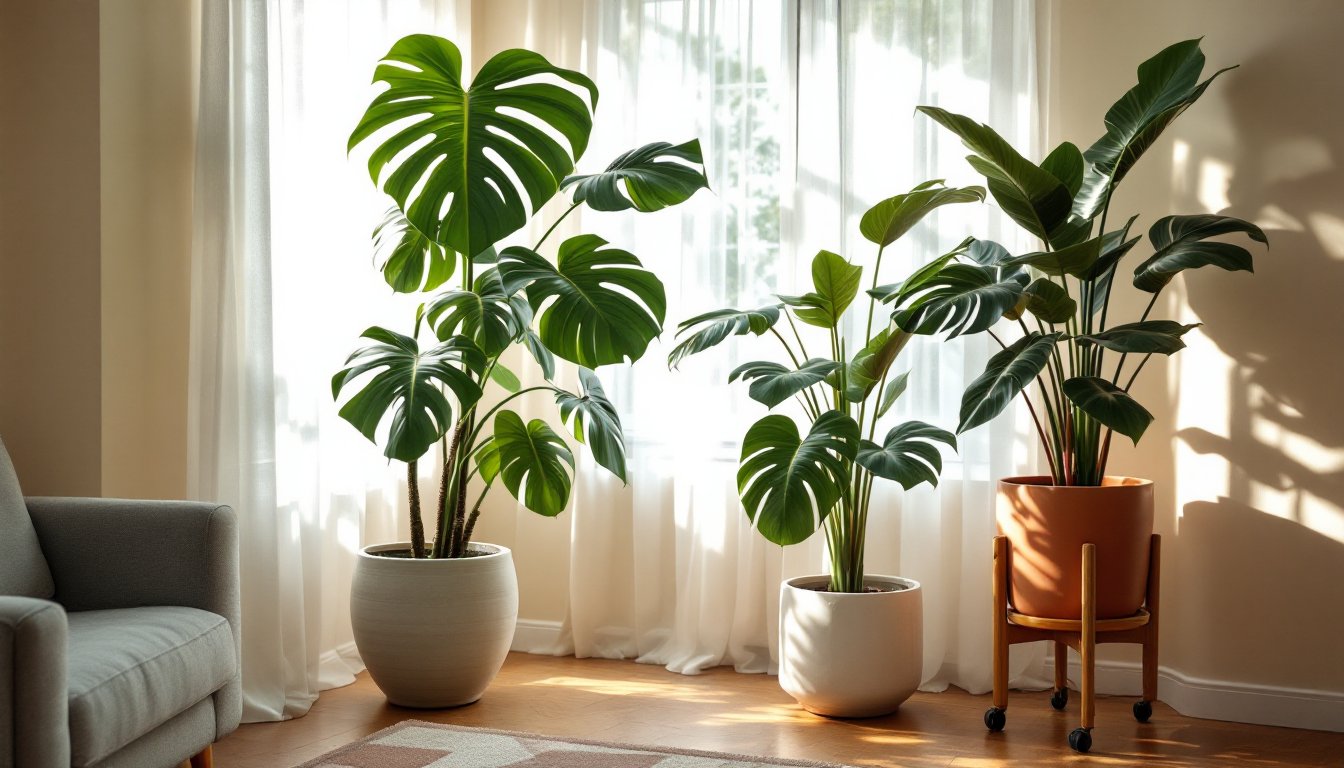
Placement strategy: Use big leaf tropicals as anchor pieces, not afterthoughts. A Monstera in the corner of a living room draws the eye upward and fills vertical space that furniture can’t. Bird of Paradise works well flanking entryways or beside sliding glass doors, where it frames the view rather than blocking it.
Avoid overcrowding. These plants need breathing room, both aesthetically and practically. Leaves pressed against walls or furniture don’t receive even light distribution and develop lopsided growth. Leave at least 12–18 inches of clearance on all sides.
Pot selection affects the overall look as much as the plant itself. Matte ceramic pots in neutral tones (white, gray, terracotta) keep the focus on foliage. High-gloss finishes compete visually and can look dated. For large specimens, consider fiberglass or resin planters, they’re lightweight compared to ceramic and easier to move for cleaning or repositioning. A 12-inch Monstera in a ceramic pot can weigh 40+ pounds: the same plant in a fiberglass pot weighs half that.
Floor protection: Large pots need saucers or trays to catch drainage, but sitting water damages hardwood and tile grout. Use saucers with cork or felt pads underneath, or place the entire pot on a plant caddy with locking wheels. Caddies (available for $15–$30 depending on size) make it easy to rotate the plant for even light exposure and simplify floor cleaning.
Pairing with decor: Big leaf tropicals suit minimalist and maximalist spaces equally well. In minimalist rooms, a single statement plant provides the organic texture that stark furniture lacks. In eclectic spaces, bold foliage contrasts with patterned textiles and busy walls, creating visual balance. According to Hunker’s overview of tropical houseplants, the key is intentional placement, treat the plant as furniture, not decoration.
Those seeking inspiration can check out curated lists among the coolest house plants for styling ideas that go beyond the typical.
Lighting adjustments: If natural light is insufficient, supplement with full-spectrum LED grow lights. Position them 12–24 inches above the canopy and run for 10–12 hours daily. Modern LED panels are unobtrusive and can mount under shelves or clip onto furniture. This isn’t a compromise, many urban dwellers successfully grow light-demanding plants entirely under artificial light.
Finally, consider scale relative to room size. A 6-foot Bird of Paradise overwhelms a small bedroom but looks proportional in a living room with 9-foot ceilings. Test placement before committing. Move the plant around (easier with a caddy) and live with it for a few days. The right spot feels obvious once you find it.
For more guidance on indoor greenery, The Spruce offers detailed plant care profiles and troubleshooting advice. And for those building a collection, reviewing a comprehensive list like the 50 most common house plants helps identify which species complement each other in terms of care requirements and visual impact.